The Battle for Cloud Sovereignty: Who Truly Owns Your Digital Sky?

The Battle for Cloud Sovereignty: Who Truly Owns Your Digital Sky?
The Battle for Cloud Sovereignty: Who Truly Owns Your Digital Sky?
Introduction – The Sky Above Us Is No Longer Empty
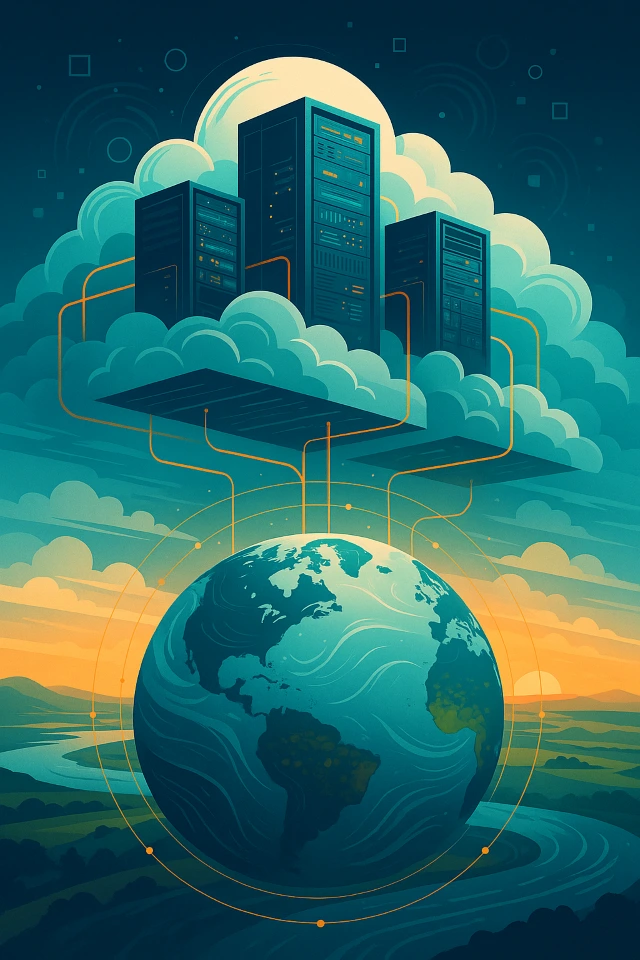
Look up, and the sky you see is no longer just air, birds, and weather. Floating invisibly above us is another atmosphere — a digital sky, humming with your photos, your tax records, your climate models, your country’s critical infrastructure. This isn’t metaphorical.
Every Google search, every payment, every satellite image, every genome sequence is stored in a physical data center, one that sits somewhere on Earth.
And the question that’s starting to unsettle nations is this:
Who owns the sky your data lives in?
Welcome to the era of cloud sovereignty — a geopolitical, scientific, and environmental power struggle where climate change, energy consumption, and national security are suddenly tangled together in one high-altitude battle.
This is no longer just an “IT issue.”
It’s a planet issue.
And the world is scrambling to decide who controls the next atmosphere humans have built.

Section I – What Is Cloud Sovereignty and Why It’s Suddenly a Global Power Weapon
Cloud sovereignty refers to a nation’s ability to control where its data is stored, how it is processed, and who has legal or political authority over it. But beneath the surface, it’s something far deeper:
- A digital extension of national territory
- A shield against foreign surveillance
- A strategic asset in war and economic competition
- A tool to enforce data localization and environmental standards
The cloud used to feel stateless. Now, governments understand that data stored in another country is effectively under another country’s laws.
A 2023 EU Commission report estimated that 92% of the West’s data is hosted by U.S. companies, while China controls ~30% of global hyperscale cloud infrastructure growth. The digital dependence is staggering.
This shift has turned cloud providers like AWS, Google Cloud, Alibaba Cloud, and Huawei Cloud into quasi-geopolitical actors. Their server locations influence trade agreements, energy grids, privacy laws, and even climate policy.
Cloud sovereignty is no longer about tech;
it’s about who holds power in the 21st century.
Section II – The Environmental Price of Owning the Digital Sky
While nations argue over who should own the cloud, the planet is quietly paying the bill.
Data centers consume about 2–3% of global electricity — equivalent to the entire aviation industry — and this could triple by 2030.
Even more surprising:
➡️ A single data center can use as much water as a town of 30,000 people (U.S. Department of Energy, 2022).
➡️ Heat waste from data centers contributes to local microclimate warming, raising nearby temperatures by 2–5°C.
➡️ Hyperscale centers can require 100–300 MW each, enough to power 80,000 homes.
And because cloud sovereignty encourages nations to build more local data centers, we’re witnessing:
- A construction boom of high-energy digital infrastructure
- Increased pressure on national grids
- Higher demand for water cooling in drought-prone regions
- Carbon-heavy redundancy systems (backup diesel generators, etc.)
Ironically, the race to control the cloud is warming the actual sky above us.
Section III – Case Studies: The Greener Clouds and the Dirty Data Wars
Case Study 1: Finland – The World’s Coolest Cloud
Finland hosts some of the most energy-efficient data centers globally.
Why?
- Arctic-adjacent climate → free cooling
- Renewable-heavy grid (wind + hydro > 80%)
- District heating loops that reuse server heat to warm homes
Google’s Hamina data center reuses 97% of its waste heat, turning servers into neighborhood heaters.
This is what a green cloud looks like.
Case Study 2: Phoenix, Arizona – The Water War in the Cloud
Phoenix is one of the fastest-growing data center hubs in the U.S.
But it’s also in the middle of a megadrought.
A 2021 investigation found major cloud operators consuming 1–4 million gallons of water per day per site — in a region rationing water for residents.
Here, cloud sovereignty meets water sovereignty.
And the environment is losing.
Case Study 3: China – The Coal-Fueled Cloud
China’s rapid cloud expansion has an environmental shadow:
about 58% of data center electricity still comes from coal.
The country leads in AI, 5G, and supercomputing, yet many of these systems run on fossil-heavy grids.
This creates a “carbon cloud” that influences global emissions and trade negotiations.
Case Study 4: Iceland – The Renewable Data Haven
Iceland runs nearly all data centers on geothermal and hydro power.
Some researchers call it a “digital national park.”
But sovereignty questions remain:
If foreign companies own the data centers — does Iceland truly own its digital sky?
Section IV – The Science Behind Cloud Energy, Water, and Heat Footprints
Cloud sustainability comes down to three resource pillars:
1. Energy Footprint
Servers demand enormous electricity to:
- Process data
- Store information
- Cool internal systems
- Maintain redundancy for uptime
AI workloads alone could consume up to 10x the power of traditional cloud computing.
2. Water Footprint
Most data centers use evaporative cooling.
For every gigawatt of heat removed, thousands of gallons evaporate into the air.
Projected global cloud water demand by 2030:
4.7 billion cubic meters annually — enough to fill 1.8 million Olympic pools.
3. Heat Footprint
Servers produce heat equivalent to industrial furnaces.
This heat escapes into the environment, forming local heat islands.
In Ireland, cloud heat waste increased local temperatures enough to trigger grid restrictions in 2022.
Cloud science is literally atmospheric science now.
Section V – The New Cold War: Nations Redrawing Borders in the Clouds
Cloud sovereignty is shifting geopolitics in ways eerily similar to the Cold War.
- The EU launched GAIA-X, a sovereign cloud framework to reduce US–China dependence.
- India is developing Digital India Cloud, requiring certain data to stay inside Indian borders.
- The US is restricting Chinese cloud access for AI training models.
- The Middle East is building energy-rich sovereign clouds to diversify economies.
Countries are effectively drawing invisible borders around their data.
And this creates alliances, rivalries, and new vulnerabilities.
A cyber breach of a foreign-owned data center is now considered a sovereignty violation in many jurisdictions.
Clouds have become strategic infrastructure — like oil pipelines or satellite networks.
The question “Where is my data stored?” now has national consequences.
Section VI – What a “Sustainable” and “Sovereign” Cloud Looks Like by 2030
A truly future-proof cloud must be both ecologically responsible and politically autonomous. Here’s the model experts envision:
1. 100% Renewable-Powered Data Centers
Instead of fossil-fuel grids, sovereign clouds must operate on:
- Wind
- Solar
- Hydro
- Geothermal
- Green hydrogen
Some countries may even enforce carbon-negative requirements.
2. Waterless or Minimal-Water Cooling
Liquid immersion cooling is emerging as a breakthrough:
Servers are submerged in non-conductive liquids, reducing water use by up to 95%.
3. Heat Recycling as Public Infrastructure
Mandatory heat reuse:
data centers will heat entire districts, agricultural greenhouses, and industrial parks.
4. Transparent Data Location Laws
People should know exactly which nation’s laws protect their data, similar to food labels.
5. AI-Efficient Cloud Workloads
AI optimization could reduce cloud energy use by 20–30% through intelligent scheduling and hardware-level efficienc
Similar to economic zones, countries will create regulated cloud territories with:
- strict environmental standards
- localized governance
- renewable energy caps
- climate resilience requirements
By 2030, owning a cloud won’t just be about control —
it will be about responsibility.
Conclusion – The Sky We Choose to Build
The battle for cloud sovereignty is not really about technology.
It’s about the kind of world we want.
A world where nations hoard digital power and pollute without consequence?
Or one where our invisible sky is built on renewable energy, ethical governance, and scientific responsibility?
We are building a second atmosphere —
a digital one —
and it will shape economies, ecosystems, and democracies.
The decision isn’t just technical;
it’s environmental, political, and profoundly human.
The sky above us is no longer empty.
The question is whether we protect it — or let it fragment and overheat in the name of power.
FAQs (Descriptive, Logical, Human-Valued Answers)
- Why does cloud sovereignty matter now more than before?
Because data is now a national resource — as critical as oil, water, or rare earth metals. With rising cyber threats, geopolitical tensions, and climate pressures, nations need control over where data is stored and how it is protected.
- Do data centers really harm the environment? How?
Yes. Through high electricity consumption, heavy water use, and heat emission. These impacts influence drought conditions, carbon load on grids, and localized warming. Cloud computing looks “digital,” but its footprint is very physical.
- Which countries are leading in sustainable cloud infrastructure?
Nordic nations (Finland, Sweden, Iceland) lead due to renewable grids and cold climates. Countries like Singapore and the UAE are investing in green data center innovation despite hot climates.
- Why are AI and cloud computing linked to higher energy use?
AI computation requires massive parallel processing, which increases electricity demand and generates more heat. Training a single large AI model can emit as much carbon as five cars over their lifetimes.
- What can individuals and companies do to reduce cloud impact?
- Choose cloud providers with transparent sustainability reports
- Adopt energy-efficient AI models
- Enable data lifecycle management (reduce storage waste)
- Support policies that enforce renewable-powered cloud zones
Even small steps — like deleting unnecessary backups — help reduce total infrastructure load.
Recent Posts
Deep-Sea Mining Ethics: The Battle for Earth’s Last Frontier
Deep-Sea Mining Ethics: The Battle for Earth’s Last Frontier The deep ocean has always felt… Read More
Neuro-Rights: The Looming Legal Battle for Cognitive Liberty in the Age of Brain-Tech
Neuro-Rights: The Looming Legal Battle for Cognitive Liberty in the Age of Brain-Tech As neurotechnology… Read More
Beyond the Screen: The Ethics of Digital Afterlife and AI Legacy Creation
Beyond the Screen: The Ethics of Digital Afterlife and AI Legacy Creation SEO Title: Beyond… Read More
From Deepfake to Deep-Art: The Unsettling Rise of AI-Generated Masterpieces
From Deepfake to Deep-Art: The Unsettling Rise of AI-Generated Masterpieces Artificial intelligence has taken a… Read More
Cinematic Cartography: How Filmmakers Invented 5 Fictional Cities That Felt Real
Cinematic Cartography: How Filmmakers Invented 5 Fictional Cities That Felt Real Introduction: Why Fictional Cities… Read More
Nomads, Nations & the Planet: The Politics of Mobility in a Warming World
Nomads, Nations & the Planet: The Politics of Mobility in a Warming World Introduction… Read More