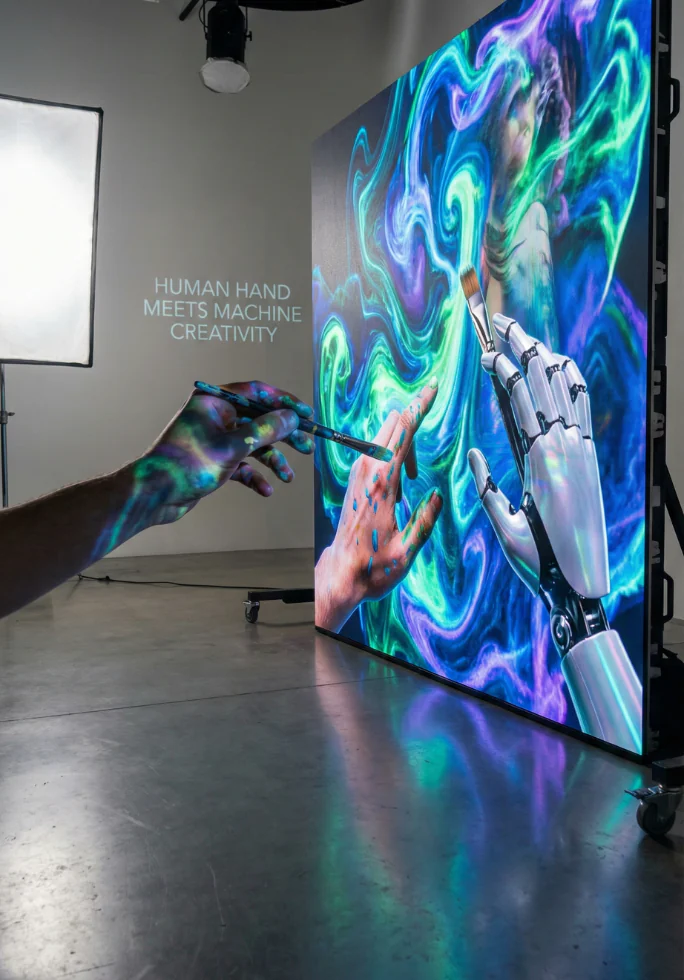
From Deepfake to Deep-Art: The Unsettling Rise of AI-Generated Masterpieces
Artificial intelligence has taken a remarkable and somewhat turbulent journey over the last decade. It began in the shadowy corners of the internet, producing unsettling deepfake videos that blurred the lines between truth and fiction. Yet, in a twist that few predicted, this same underlying technology has blossomed into a medium capable of creating breathtaking AI-generated masterpieces that are now showcased in prestigious digital galleries worldwide.
What began as a technology associated with manipulation and deception has transformed into a powerful engine of creativity, sparking excitement, fierce debate, and profound ethical concern. We stand at a crossroads where algorithms are no longer just processing data; they are dreaming.
Today, Deep-Art represents both a creative revolution and a philosophical challenge. It asks us to rethink what “artistry” means in a world where human imagination works alongside—and sometimes competes with—machine intelligence. This is the story of how the digital lie became the digital canvas.
Understanding the Evolution from Deepfake to Deep-Art
To truly appreciate the current wave of AI-generated masterpieces, one must understand their chaotic ancestry. The transformation from deepfake technology to high art did not happen overnight; it unfolded through years of experimentation, controversy, and rapid algorithmic innovation.
The Origins of Deepfake Technology
The story begins around 2014 with the invention of Generative Adversarial Networks (GANs) by researcher Ian Goodfellow. This was the spark that lit the fuse. Deepfakes emerged from these systems, which essentially consist of two neural networks locked in a competitive game.
Early uses of this technology were often dismissed as harmless novelties. We saw face-swapping apps that allowed users to trade faces with celebrities, social media filters that aged us by decades, and entertainment memes that flooded the internet. However, as the computing power behind these networks grew, the “uncanny valley” began to close.
As deepfakes grew more realistic, they triggered serious global concerns around:


- Misinformation: Politicians were made to say things they never said.
- Identity Manipulation: The likeness of innocent individuals was grafted onto adult content without consent.
- Political Propaganda: State actors began using synthetic media to destabilize trust in news.
- Privacy Invasion: The realization that one’s digital face could be stolen and repurposed.
When Deepfake Became Deep-Art
Yet, amid this controversy, a different group of pioneers—artists, coders, and visionaries—saw something else in the code. They realized that the same mechanism used to forge a fake identity could be used to hallucinate entirely new forms of beauty.
Google’s “DeepDream” was an early harbinger of this shift, turning ordinary photos into psychedelic tapestries of eyes and dogs. But the real shift occurred when creators stopped asking AI to copy reality and started asking it to reimagine it. Instead of forging fake identities, AI tools were repurposed to:
- Remix artistic styles: Applying the brushstrokes of Van Gogh to a photograph of modern New York.
- Generate surreal environments: Creating landscapes that defy the laws of physics but adhere to the laws of composition.
- Reinterpret historic artworks: breathing motion and new life into static Renaissance paintings.
- Create entirely new visual aesthetics: producing “glitch art” and “latent space” navigations that no human hand could execute manually.
This shift marked the birth of Deep-Art. The narrative flipped from “deception” to “expression,” and the era of AI-generated masterpieces began.
How AI-Generated Masterpieces Are Created
The creation of an AI masterpiece is not magic, though it often feels like it. It is a complex interplay of mathematics, probability, and vast datasets.
Neural Networks and Generative Models
Modern Deep-Art relies on a suite of advanced models that have evolved significantly since the early days of simple GANs.
- GANs (Generative Adversarial Networks): Imagine a forger and a detective. The “Forger” (Generator) creates an image, and the “Detective” (Discriminator) tries to guess if it is real or fake. Over millions of rounds, the Forger gets so good that the Detective can no longer tell the difference. This tension creates incredibly realistic visuals.
- VAEs (Variational Autoencoders): These models compress data into a dense representation and then reconstruct it, often finding new variations in the process.
- Diffusion Models: This is the technology behind giants like Midjourney and DALL·E. Imagine taking a clear photograph and slowly adding static (noise) until it is unrecognizable gray dust. The AI learns to reverse this process—starting with static and hallucinating a clear image out of the chaos based on a text prompt.
- Transformers: Originally built for language (like ChatGPT), these now help image models understand the context of a prompt, linking the word “sunset” to the visual hues of orange and purple.
The Role of Machine Learning in Artistic Output
Machine learning allows these systems to analyze millions of images, learning structures, patterns, textures, and styles—not to copy them pixel-for-pixel, but to understand their “essence.” The AI learns:
- Brushstroke patterns: How an Impressionist dabs paint versus how a Realist blends it.
- Color harmony: Which palettes evoke sadness, joy, or futuristic tension.
- Composition rules: The Golden Ratio, the rule of thirds, and leading lines.
- Stylistic signatures: The melting clocks of Dalí or the geometric abstraction of Picasso.
This training allows the AI to synthesize these concepts into something new. When a user prompts for a “cyberpunk city in the style of Hokusai,” the AI isn’t cutting and pasting; it is painting a new concept using the logic of Hokusai and the texture of cyberpunk.
Creativity vs. Computation
This leads to the central philosophical question of our time: Can a machine be creative?
AI does not possess emotion. It has never felt the warmth of the sun or the sting of heartbreak. However, it creates novelty through high-dimensional pattern recognition. It can connect concepts that a human mind might never associate.
This computational creativity opens new debates:
- What defines an artist? Is it the person who types the prompt, or the engineer who built the model?
- Where does originality come from? If all art is derivative, is AI just doing what humans do, but faster?
- Can a machine be considered creative? Or is it merely a mirror reflecting our collective culture back at us?
The Cultural Impact of AI-Generated Art
The rise of AI-generated masterpieces has sent shockwaves through the landscape of art, entertainment, and media. We are witnessing a disruption comparable to the invention of the camera.


Disruption in Traditional Art Industries
For traditional artists, this rise is a double-edged sword. Some fear that AI will devalue human skill, flooding the market with cheap, instant illustrations. Concept artists, illustrators, and stock photographers are already seeing their industries shift beneath their feet.
However, others embrace it as a tool that expands artistic boundaries. Just as the synthesizer did not kill the orchestra but gave birth to electronic music, AI is creating a new genre. Today, we see:
- AI-driven art exhibitions: Museums like MoMA have acquired AI pieces, and digital galleries are booming.
- Collaborations: Artists using AI to generate base layers which they then paint over by hand.
- NFT Marketplaces: The crypto-art boom was fueled largely by generative art collections.
How Consumers Perceive AI Art
Public opinion remains deeply split.
- Supporters praise the democratization of creativity. For the first time in history, a person with a vivid imagination but poor manual dexterity can visualize their dreams.
- Skeptics argue that AI art lacks “soul” or human sentiment. They view the perfection of AI images as sterile or “uncanny.”
Despite criticism, global interest in AI art continues to rise, with AI-generated masterpieces fetching high prices at auctions, proving that the art world is ready to take this medium seriously.
Ethical Dilemmas Behind Deep-Art Innovations
We cannot discuss the beauty of Deep-Art without acknowledging the shadows it casts. Deep-Art inherits many ethical concerns from the deepfake era, and introduces new ones.
Copyright Challenges in AI Art
The most heated battleground today is copyright. AI models are trained on billions of images scraped from the internet—including the copyrighted works of living artists. This raises difficult questions:
- The “Style” Theft: If an AI can perfectly mimic a specific artist’s style, is that infringement? Current laws generally protect specific images, not “styles,” leaving artists vulnerable.
- Compensation: Should artists be compensated if their work is used to train a model that eventually competes with them?
- Transparency: Do AI companies have a duty to disclose their training data?
Major lawsuits are currently winding their way through courts, and the outcomes will define the future of digital creativity.
Authenticity and Attribution Problems
Ownership is unclear in the AI era. If I type a prompt into Midjourney, do I own the image?
- The Human Prompter: Argues they provided the creative spark.
- The AI Model: The system did the heavy lifting.
- The Original Artists: Their work provided the “vocabulary” the AI used to speak.
In the US, recent copyright rulings have suggested that purely AI-generated works cannot be copyrighted because they lack “human authorship.” This leaves AI-generated masterpieces in a strange legal limbo—valuable, yet potentially unownable.
Potential for Manipulation and Deception
While we focus on art, the tools of Deep-Art are the same as those of Deepfakes. The ability to generate photorealistic images of events that never happened remains a threat. Ethical guardrails—such as watermarking AI content and restricting the generation of real people’s likenesses—are crucial to preventing this artistic tool from becoming a weapon of disinformation.
Modern Use Cases of AI-Generated Masterpieces
Beyond the gallery walls, AI art has become mainstream across industries, reshaping how we consume visual media.
Entertainment & Digital Media
Hollywood and game studios are adopting these tools rapidly.
- Concept Art: Directors can visualize alien worlds in seconds during brainstorming sessions.
- VFX Prototyping: AI can generate rough textures and background elements, speeding up production.
- Character Generation: Creating diverse crowds of non-playable characters (NPCs) in video games without modeling each one manually.
Advertising & Marketing
Brands are leveraging AI to create hyper-personalized content.
- Campaign Visuals: Generating hundreds of variations of an ad to see which color palette resonates with a specific demographic.
- Social Media Creatives: Influencers and brands use AI to create eye-catching, surreal imagery that stops the scroll.
- Product Mockups: Visualizing new sneaker designs or furniture layouts without manufacturing a prototype.
Personal Creativity & Hobbyists
Perhaps the most profound impact is on the individual. With tools like Midjourney, Stable Diffusion, and DALL·E, millions of people are engaging in artistic play. Writers use it to visualize their characters; dungeon masters use it to show players their fantasy worlds; dreamers use it to log their subconscious.
What the Future Holds for Deep-Art
As we look toward 2030, the line between human and machine art will likely blur further.
Regulatory Frameworks and Digital Safety
Governments and tech platforms are developing guidelines (like the C2PA standard) to digitally sign media, proving its origin. This will help distinguish a human photograph from an AI generation, preserving the value of truth while allowing fiction to flourish.
Collaborative AI Artistry
The future is likely not “AI vs. Human,” but “AI + Human.” We are moving toward a “Centaur” model of creativity.
- The Co-Creator: Imagine a Photoshop that listens. You sketch a rough circle, and the AI turns it into a realistic moon. You adjust the lighting, and the AI recalculates the shadows.
- Interactive Art: Artworks that change based on who is looking at them, powered by real-time generative engines.
FAQs — From Deepfake to Deep-Art
- What’s the difference between deepfakes and Deep-Art? Deepfakes primarily aim to manipulate identities or realism, often to deceive (e.g., swapping faces). Deep-Art focuses on creative, expressive, and often abstract visuals intended to evoke emotion or aesthetic appreciation, not deception.
- Is AI-generated art considered original? This is a complex philosophical and legal question. While the pixel arrangement is technically “new” and unique, the AI creates it by synthesizing patterns from existing data. It is original in output, but derivative in method.
- Can AI replace human artists? AI is expected to augment human creativity rather than replace it entirely. While it may automate technical tasks (like texture generation), the human elements of intent, emotion, and storytelling remain distinct.
- Is Deep-Art dangerous? It can be. The same tools used for art can be used to create propaganda or offensive material. However, the artistic application itself is generally safe; the danger lies in the lack of labeling and malicious misuse.
- How can I create AI-generated art? You can access tools like Midjourney (via Discord), DALL·E (via ChatGPT), or open-source software like Stable Diffusion. These platforms allow you to type text prompts to generate images.
- Who owns AI-generated art? Currently, US law states that purely AI-generated art cannot be copyrighted. However, if there is significant human input (painting over it, heavy editing), it may be eligible. Global laws are still developing.
Conclusion
From deepfake’s troubling roots to the rise of stunning AI-generated masterpieces, AI has reshaped how we perceive creativity and truth. From Deepfake to Deep-Art: The Unsettling Rise of AI-Generated Masterpieces reveals a future where human artistry merges with machine intelligence.
We are no longer just looking at screens; we are looking into mirrors that reflect the vast, chaotic, and beautiful sum of human visual culture. With ethical guidelines and responsible innovation, Deep-Art could become one of the most transformative creative movements of our time—not by replacing the human touch, but by giving it a limitless new brush.